How Nettlewyck Organises and Presents Information
This section describes what the Nettlewyck platform is intended to do, how its interface is organised, and what users should understand before submitting an access request.
The purpose of the platform
Nettlewyck is an AI-enabled information-organisation system. Its purpose is to receive, classify, and present structured information in a way that makes it easier for users to locate, review, and act upon what is relevant to them.
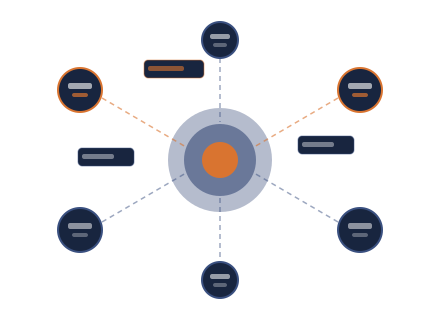
The service operates as an intermediary layer between raw information and the user. Rather than presenting an unstructured feed, Nettlewyck applies classification logic to group records into coherent categories, label entries with appropriate descriptors, and surface related items within a navigable interface.
This approach is intended to reduce the effort involved in information review and to support more deliberate, focused interaction with available data.
What the interface makes available
Categorised information panels
Records within Nettlewyck are grouped by category and displayed in labelled panels. Users can navigate between panels without losing their position within the broader dataset.
Entry-level detail views
Selecting an individual record opens a detail view that shows all available fields for that entry, along with any linked records or associated classifications.
Filter and sort controls
The interface includes controls for filtering the visible dataset by category, date range, or other available fields. Sorting options allow users to reorder results according to their review priorities.
Structured summary displays
High-level summaries aggregate available information into readable overviews. These are useful for forming an initial understanding before drilling down into individual entries.
Activity log and session history
Users can review which sections of the interface they have visited during a session and return to previously examined records without re-navigating from the beginning.
Enquiry and support access
A dedicated channel is available within the interface for submitting questions to the Nettlewyck support team. Responses are routed through the same interface for continuity.
Before you request access
The information presented through Nettlewyck is drawn from the datasets made available to the service. Its accuracy, completeness, and currency depend on the sources from which it originates. Nettlewyck classifies and organises this information but does not independently verify every record.
Users should treat the information available through the service as an organised reference rather than a verified authoritative source. Where accuracy is critical for a particular decision, users are encouraged to cross-reference with primary sources.
Access to the service is subject to review. The team may request additional information before confirming access. There is no guarantee that every access request will result in confirmed access.
Frequently asked questions
What type of information does Nettlewyck organise?
Nettlewyck is designed to work with structured datasets that benefit from classification and review. The specific categories of information available depend on the datasets connected to the service and may vary between user accounts.
Does the platform update information automatically?
Information within the service reflects what is available from connected sources at the time of retrieval. The frequency of updates varies by dataset. The interface does not alter the underlying records; it presents them as received.
Can the classification categories be customised?
The interface includes standard classification categories defined by the service. Customisation options, where available, would be discussed as part of the access process. The team can clarify what configuration is available for a given account type.
Is Nettlewyck suitable for reviewing large volumes of information?
The service is designed to handle structured datasets of varying sizes. The filter, sort, and summary features are specifically intended to make larger volumes of information more navigable. Performance characteristics for specific dataset sizes would be discussed during access review.
How long does the access process take?
The access process involves reviewing the submitted enquiry and, where necessary, requesting further information. The team aims to respond to all enquiries in a reasonable time. No specific response time can be guaranteed.